

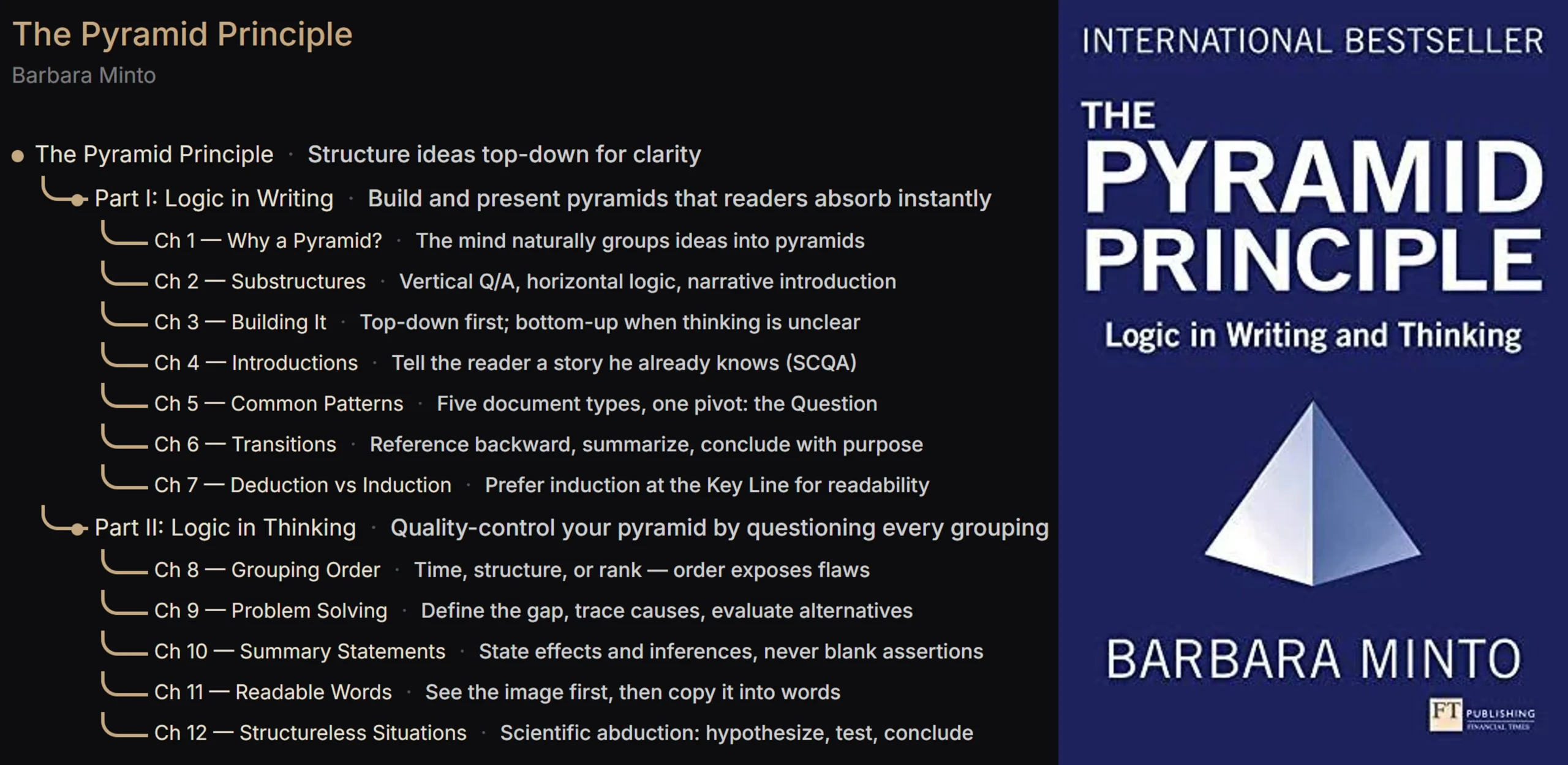
The Pyramid Principle, by Barbara Minto (Book summary)

The Pyramid Principle by Barbara Minto is a rare book — and a criminally underrated one. Once the McKinsey bible for structured communication, it has no Kindle edition, no viral following, and an entire generation of professionals who've never heard of it. It is slowly disappearing — and that feels like a quiet intellectual loss. I encountered this book early in my career and it rewired the way I think. It became a permanent standard I've never stopped respecting. If you've ever struggled to make your ideas land clearly, what Minto built here will change how you communicate forever. Read the full summary below.

Overview:

The Pyramid Principle — Logic in Writing and Thinking

The Pyramid Principle

Barbara Minto
The Pyramid Principle · Structure ideas top-down for clarity
Part I: Logic in Writing · Build and present hierarchies that readers absorb instantly
Ch 1: Why a Pyramid? · The mind naturally groups ideas into hierarchical structures
Ch 2: Substructures · Vertical Q/A, horizontal logic, narrative introduction
Ch 3: Building It · Top-down first; bottom-up when thinking is unclear
Ch 4: Introductions · Tell the reader a story he already knows (SCQA)
Ch 5: Common Patterns · Five document types, one pivot: the Question
Ch 6: Transitions · Reference backward, summarize, conclude with purpose
Ch 7: Deduction vs Induction · Prefer induction at the Key Line for readability
Part II: Logic in Thinking · Quality-control your pyramid by questioning every grouping
Ch 8: Grouping Order · Time, structure, or rank — order exposes flaws
Ch 9: Problem Solving · Define the gap, trace causes, evaluate alternatives
Ch 10: Summary Statements · State effects and inferences, never blank assertions
Ch 11: Readable Words · See the image first, then copy it into words
Ch 12: Structureless Situations · Scientific abduction: hypothesize, test, conclude

Mood board:

The Pyramid Principle — Logic in Writing and Thinking

The Pyramid Principle

Visual atmosphere
The full pyramid structure showing governing thought down to supporting arguments and evidence
“The order in which you present your ideas is the single most important act necessary to clear writing.”
— Barbara Minto
Single governing thought at apex with grouped arguments below
Pyramid substructures: vertical, horizontal, and introductory flow
Key line points supporting the governing thought
“Solving a problem simply means representing it so as to make the solution transparent.”
— Herbert Simon
Hierarchical framework for organizing arguments top-down
Argument flow diagram showing deductive and inductive reasoning paths
Ideas grouped by logical similarity under a governing thought
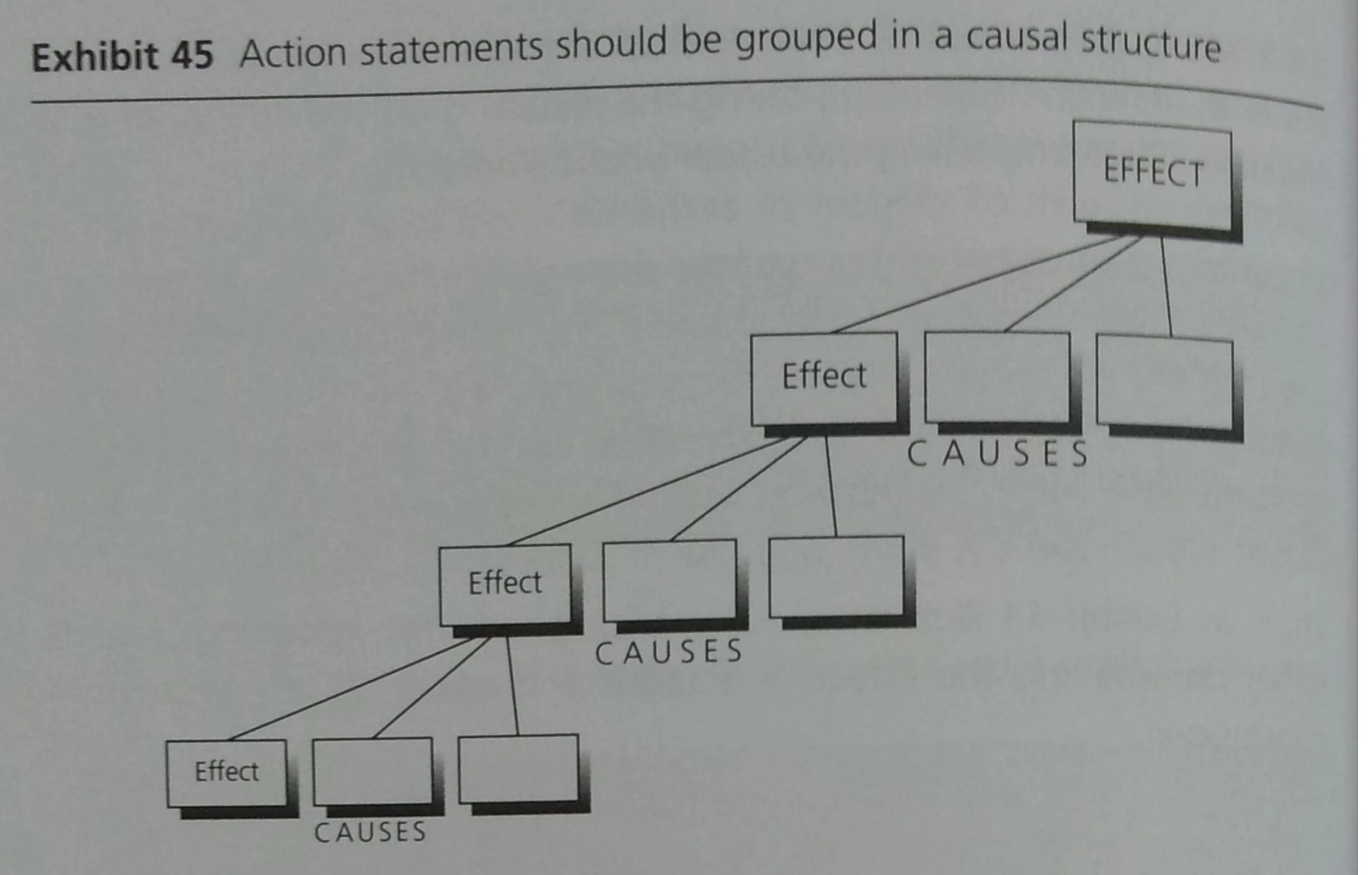
Hierarchical grouping of action ideas by their effect

Expandable/ Collapsible Text:

The Pyramid Principle — Logic in Writing and Thinking

The Pyramid Principle

by Barbara Minto
12 chapters · 2 parts · Generated 2026-04-20

Part One: Logic in Writing

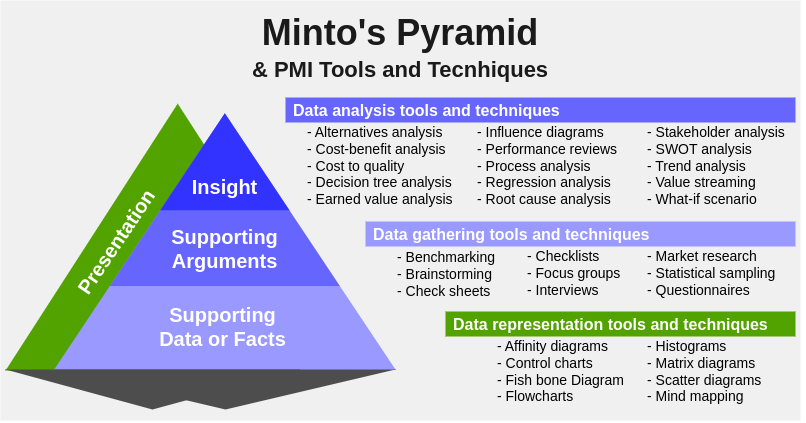
Clear writing requires organizing ideas in a pyramid — a single governing thought supported by logically grouped sub-ideas — built through question-answer dialogue, SCQA (Situation, Complication, Question, Answer) introductions, smooth transitions, and preferably inductive Key Line structure.

Chapter 1 — Why a Pyramid Structure?

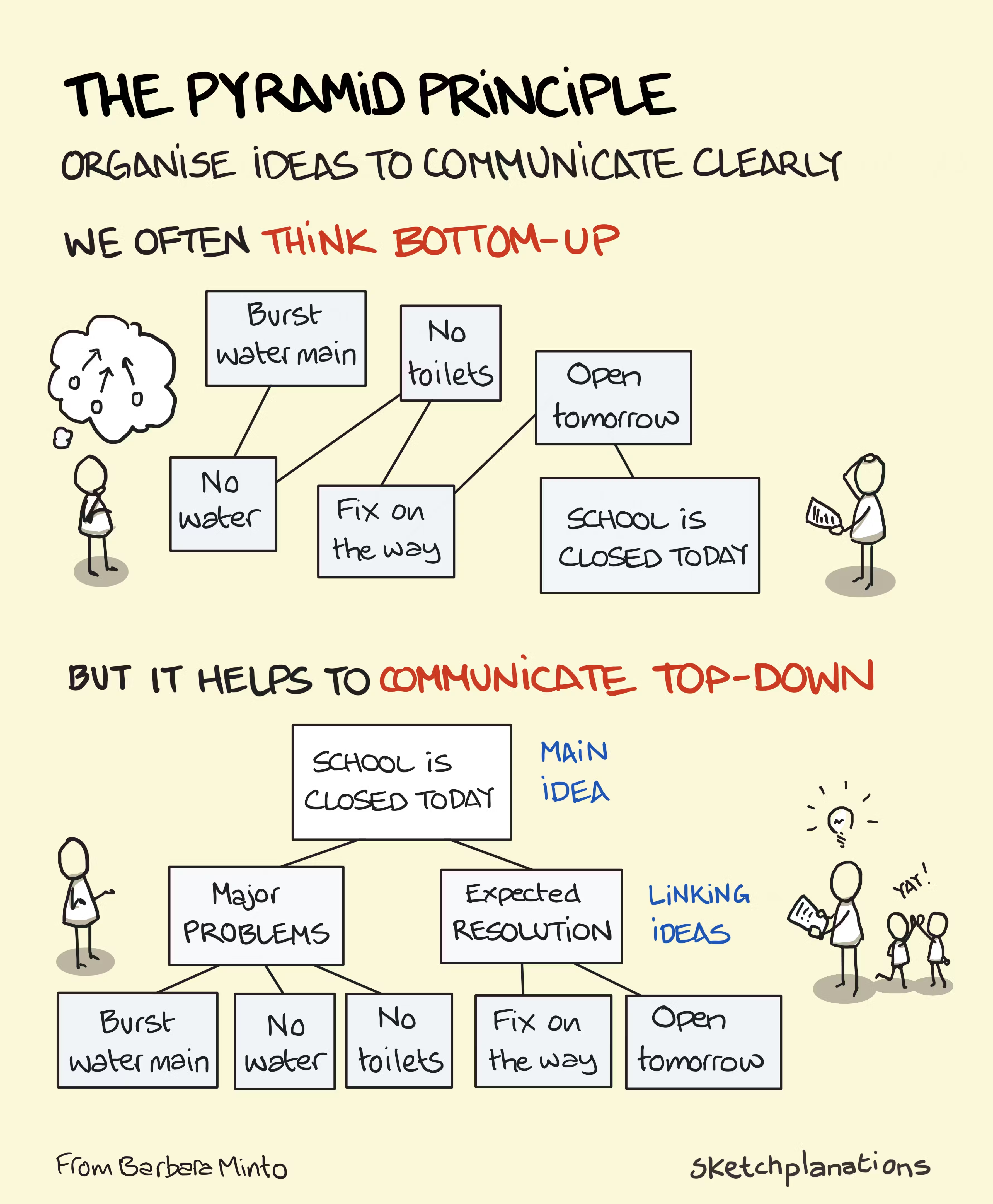
The mind automatically sorts information into pyramidal groupings, so writers should deliberately structure documents top-down in pyramid form to match how readers comprehend.

The human mind can hold only about seven items in short-term memory at once. When confronted with more, it instinctively clusters them into logical groups, creating a hierarchy. Minto argues that because the reader's mind works this way, writing must mirror the process — presenting ideas from the top down, each level summarizing the one beneath it.

This is the pyramid: a structure where every idea at every level summarizes the ideas grouped beneath it. Three rules govern a proper pyramid: every idea must summarize the ideas grouped below it, ideas in each grouping must be logically alike, and ideas within each group must be in a logical order.
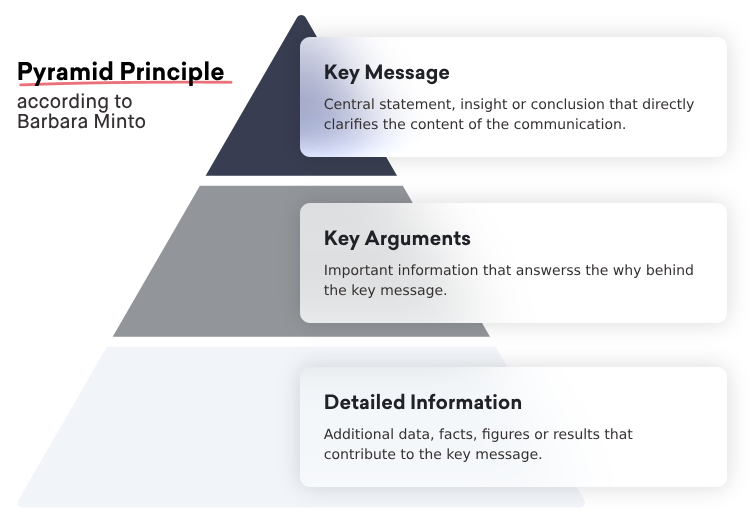
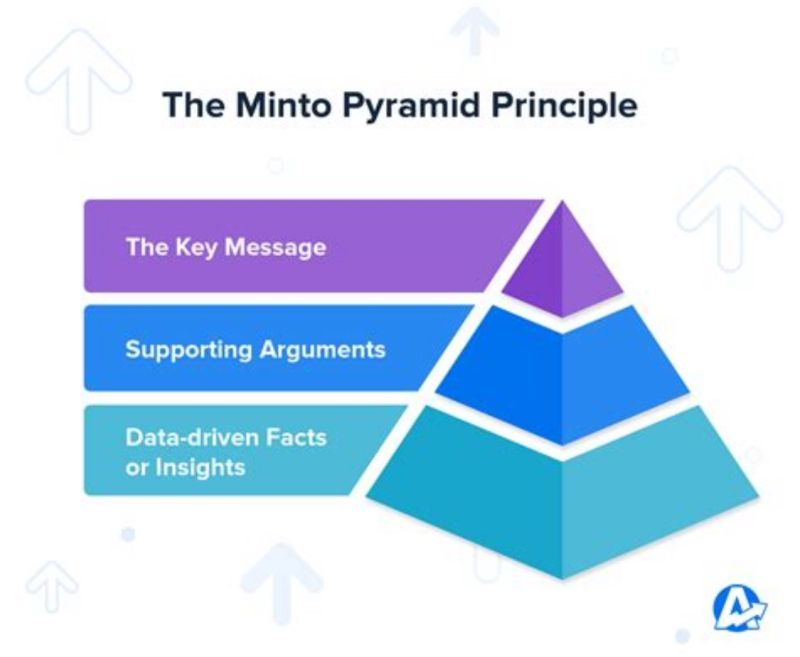
The pyramid: a single governing thought at the top, supported by grouped arguments below.
"The order in which you present your ideas is the single most important act necessary to clear writing." — The Pyramid Principle, Chapter 1

Chapter 2 — The Substructures Within the Pyramid

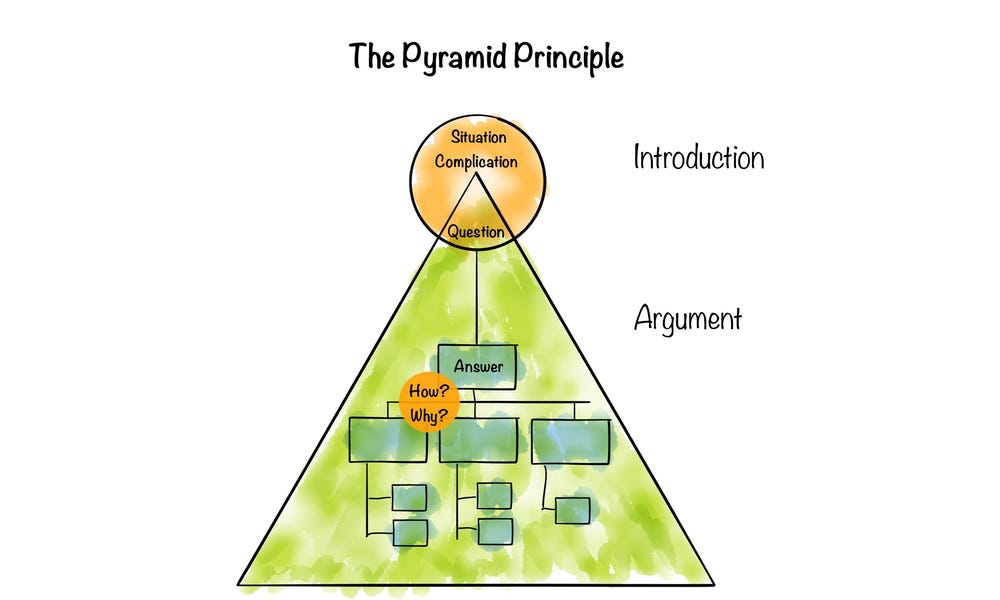
The pyramid contains three substructures — a vertical question/answer dialogue, a horizontal deductive or inductive argument, and a narrative introductory flow (SCQA) — that together guide both the discovery and presentation of ideas.

Vertically, every point in the pyramid raises a question in the reader's mind, and the points directly below it answer that question. Horizontally, the ideas in each group must present either a deductive chain (premise → premise → therefore) or an inductive grouping (similar ideas → inference). There is no third option — every grouping is one or the other.
The three substructures: vertical dialogue, horizontal logic, and narrative introduction.

The introduction follows the classic narrative pattern of Situation, Complication, Question, Answer (SCQA). This ensures the reader already cares about the question the document will answer before encountering the answer itself.

"This classic pattern of story-telling — Situation, Complication, Question, Answer — permits you to make sure that you and the reader are 'standing in the same place' before you take him by the hand and lead him through your thinking." — The Pyramid Principle, Chapter 2

Chapter 3 — How to Build a Pyramid Structure

Build your pyramid using either a top-down approach (starting with the subject and SCQA introduction) or a bottom-up approach (listing points, finding relationships, drawing conclusions), always trying top-down first.

The top-down approach is always preferred. Start by identifying your subject, determine the Question the reader needs answered, formulate your Answer, and then check whether it resolves the Situation and Complication properly. This method forces you to think about reader needs from the very beginning.
Key Line points each answer a question raised by the governing thought.

When your thinking isn't yet developed enough for the top-down approach, the bottom-up rescue works: list everything you want to say, look for relationships between the points, and draw conclusions that become higher-level groupings. Either way, the goal is the same — a pyramid you can defend logically at every level.

"The purpose of the entire exercise is to make sure you know what Question it is you are trying to answer. Once you have the Question, everything else falls into place relatively easily." — The Pyramid Principle, Chapter 3

Chapter 4 — Fine Points of Introductions

The introduction must tell the reader a story he already knows — following Situation-Complication-Question-Answer — to push aside competing thoughts, establish shared context, and make the reader receptive to your argument.

An introduction is not a summary of what follows. It is a narrative that reminds the reader of something he already knows (the Situation), introduces a tension (the Complication), and thereby raises the one Question the document exists to answer. The SCQA order can be varied for different tones — lead with the Situation for a considered tone, the Answer for directness, the Complication for urgency.

Regardless of order, every element must be present — omit one and the reader feels unmoored. The Key Line must always state ideas, not category labels: "there are three reasons" tells the reader nothing, while stating the three reasons tells him everything.

"A good introduction does more than simply gain and hold the reader's interest. It influences his perceptions." — The Pyramid Principle, Chapter 4

Chapter 5 — Some Common Patterns

Five common document types — directives, requests for funds, 'how to' documents, letters of proposal, and progress reviews — each follow a predictable SCQA pattern, with the Question always being the pivot.

Once you recognize the SCQA pattern, you see it everywhere. A directive plants an implied question about how to act. A funding request seeks approval. A 'how to' document compares the current process against the recommended one. A proposal follows the pattern of problem, approach, and people. A progress review builds on previous findings.

The document type merely determines the predictable shape of the Situation and Complication; the discipline of finding the pivot Question remains universal.

"The pivot on which your entire document depends is the Question, of which there is always only one to a document." — The Pyramid Principle, Chapter 5
Chapter 6 — Transitions Between Groups

Use three transitional techniques — referencing backward, summarizing, and concluding — to keep the reader's mind precisely where it needs to be.
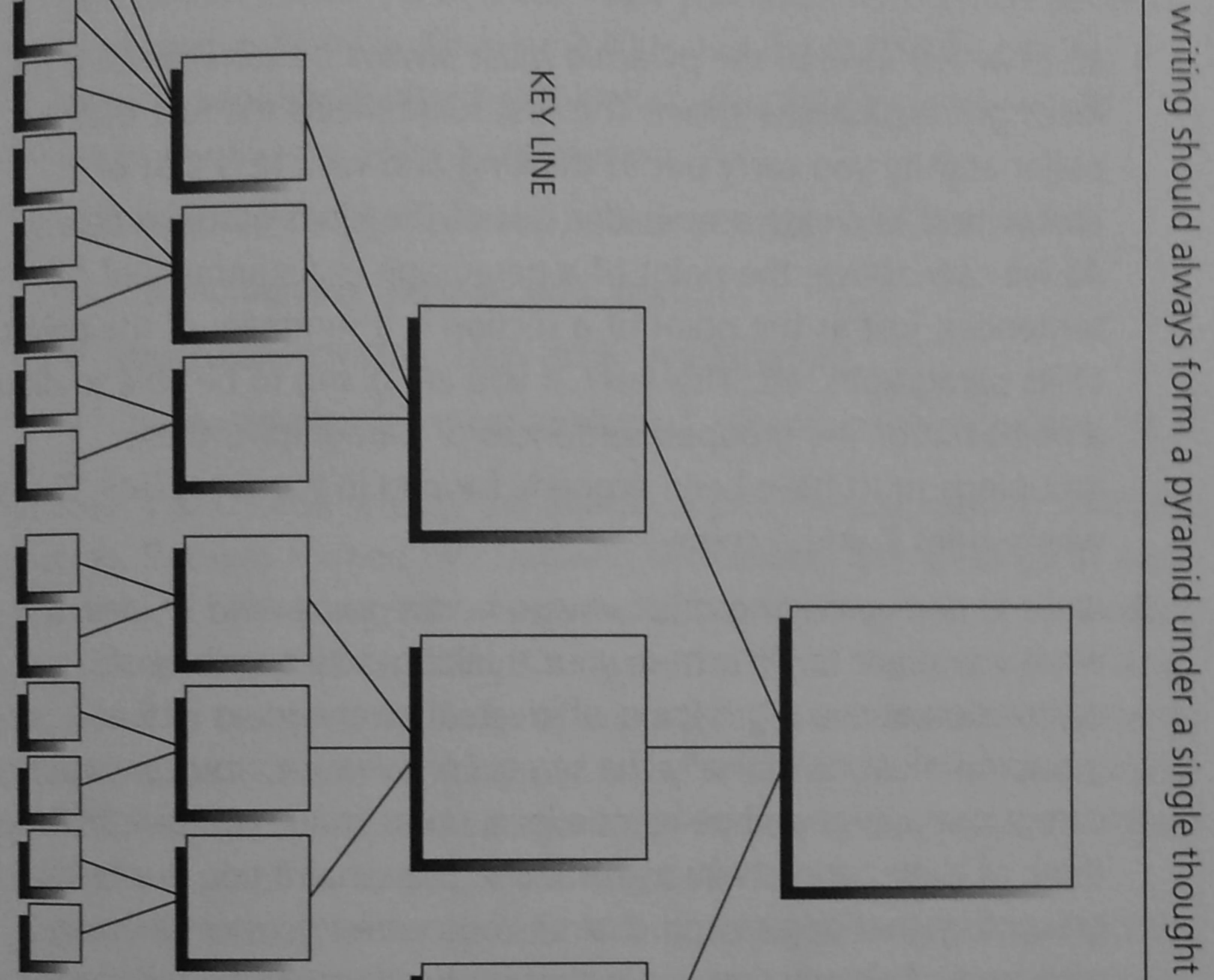
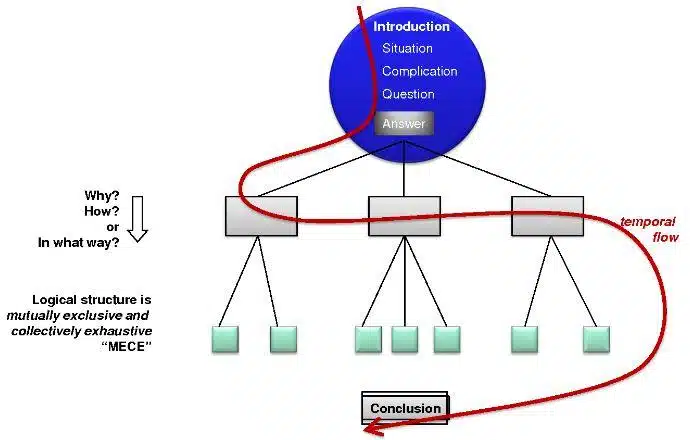
Minto's full pyramid schematic with SCQA introduction circle, Key Line, MECE groupings, temporal flow, and conclusion
Minto's full-page schematic: SCQA introduction at top (Situation, Complication, Question, Answer), vertical question–answer dialogue down through the Key Line, horizontal MECE groupings of supporting points, temporal flow overlay, and conclusion.

Transitions are the connective tissue of clear writing. Referencing backward means picking up a key word or phrase from the preceding section and carrying it into the opening of the next. Summarizing consolidates complex ideas at the end of long sections before moving forward. Concluding creates the appropriate emotion or call to action — but only when genuinely needed.

The goal throughout is to make thinking as easy as possible for the reader by relating ideas to each other, not merely to section labels.

"If you insist on appending a conclusion, you will want to write something that puts into perspective the significance of your message." — The Pyramid Principle, Chapter 6

Chapter 7 — Deduction and Induction: The Difference

Deductive reasoning chains successive steps toward a "therefore" conclusion while inductive reasoning groups similar ideas under a plural noun and draws an inference — and at the Key Line level, inductive structure is almost always preferable.

A deductive argument is a chain: major premise, minor premise, conclusion. It is rigorous but ponderous — the reader must hold the first premise in mind through pages of development before reaching the payoff. An inductive argument groups similar ideas and invites the reader to see what they have in common — the inference emerges naturally.
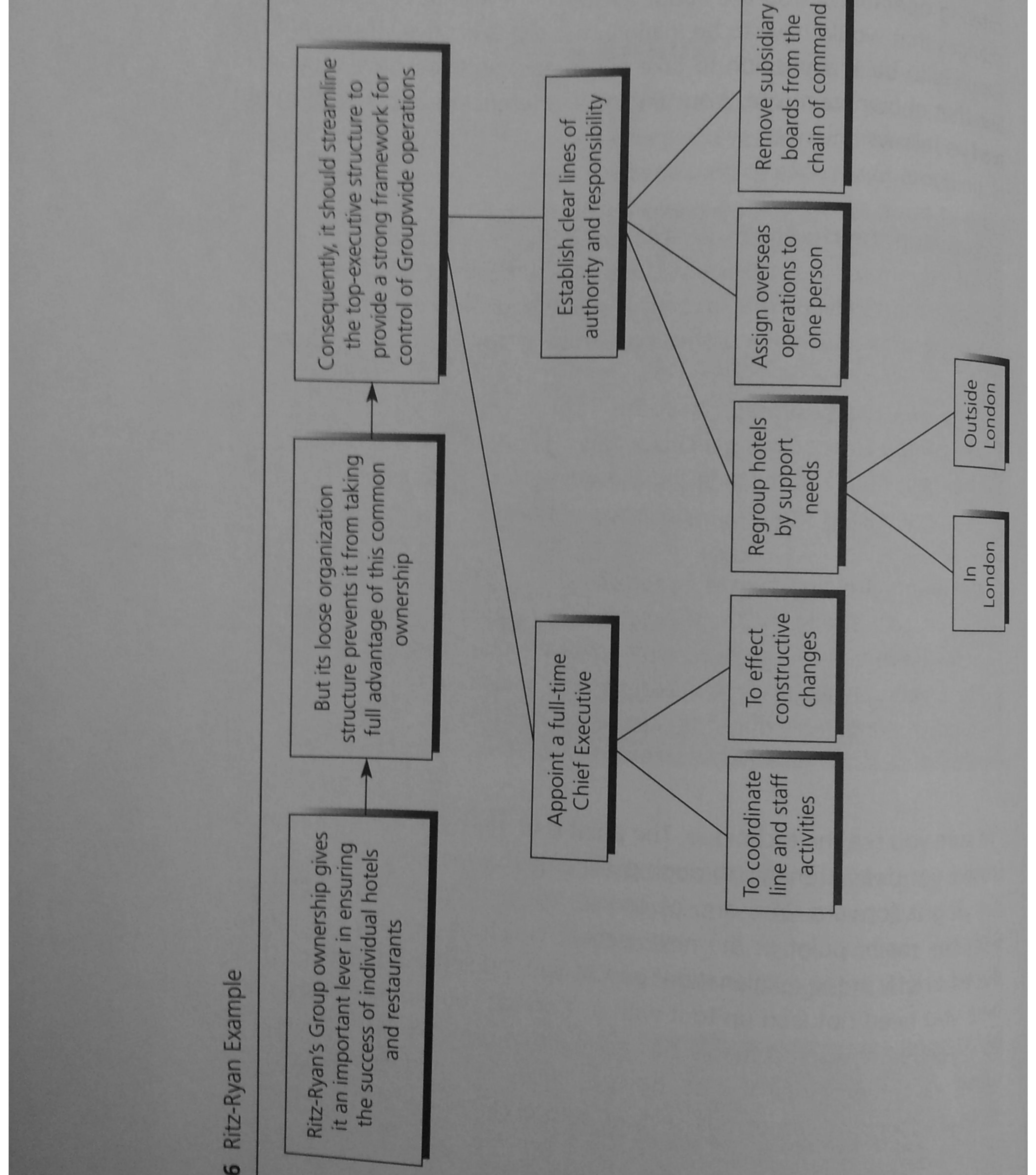
Deductive chains vs. inductive groupings at the Key Line level.

At the Key Line level — the first tier of support under the governing thought — Minto is unequivocal: prefer induction. The reader grasps the point immediately and examines evidence at leisure. Use formatting — headings, numbering, indentation — to make the pyramid visually explicit.

"As a rule of thumb, it is always better to present the action before the argument, since that is what the reader cares about." — The Pyramid Principle, Chapter 7

Part Two: Logic in Thinking

Quality-control the pyramid by questioning the logical order of groupings, verifying problem definitions, ensuring summary statements make precise leaps, visualizing ideas as images before writing, and extending the framework to structureless situations via scientific abduction.

Chapter 8 — Questioning the Order of a Grouping

The order of ideas in an inductive grouping must reflect the analytical activity that created it — time order, structural order, or ranking order — and questioning this order is the primary means of checking validity.

Every inductive grouping was created by one of three analytical activities, and the order of the ideas must match. Process-derived groupings follow time order: first this, then that, then the next. Structure-derived groupings follow structural order: the parts of a whole, which must be mutually exclusive and collectively exhaustive (MECE). Classification-derived groupings follow ranking order: items sorted by a shared characteristic, strongest first.

Grouping order must match the analytical source: time, structure, or ranking.

Questioning the order is the fastest diagnostic tool available. It exposes incomplete thinking, confused logic, and false groupings — problems invisible until you impose structure and test it.

"You cannot tell that anything is being written unless you first impose a structure on it. It is the imposition of the structure that permits you to see flaws and omissions." — The Pyramid Principle, Chapter 8

Chapter 9 — Questioning the Problem-Solving Process

Problem solving follows a sequential process — define the problem (the gap between current and desired state), identify where it lies, determine why it exists, and decide what to do — and these analytical structures guide both the analysis and the writing.

A problem is a gap between what is and what should be. Minto breaks the solving process into five sequential questions: What is the problem? Where does it lie? Why does it exist? What could we do about it? What should we do? Five types of logic trees — financial, task, activity, choice, and sequential — reveal where problems lie and trace their causes.

Five types of logic trees reveal where problems lie and trace their causes.

The problem definition maps directly to the SCQA introduction: the Situation is the current state, the Complication is the gap, and the Question is what to do about it. The choice of tree depends on the nature of the problem, but the discipline is the same — visualize the situation before you analyze it.

Chapter 10 — Questioning the Summary Statement

Summary statements must not be intellectually blank assertions but must state either the effect of action ideas or the specific inference drawn from situation ideas — forcing your thinking upward to produce real insights.

"There are three problems" is not a summary — it is a placeholder where a summary should be. Minto calls these "intellectually blank assertions": they report the existence of ideas without saying anything about them. For action ideas, the summary must state the specific, measurable end-product of carrying out those actions. For situation ideas, it must state the precise inference that applies to those particular ideas and no others.

Action ideas grouped by cause and effect, not by vague similarity.

Vague summaries kill thinking; precise summaries drive it forward.

"Always ask yourself of any group, 'Why have I brought together these particular ideas and no others?' The answer will be either that they all fall into the same narrowly defined category, or that they are all the actions that must be taken together to achieve a desired effect." — The Pyramid Principle, Chapter 10

Chapter 11 — Putting It into Readable Words

Clear writing requires consciously visualizing the images behind your ideas before writing — finding the nouns, seeing their relationships as a skeletal image, then copying that image into words the reader can reconstruct.

Most business writers are fluent speakers who become jargon-heavy writers. Minto argues this happens because they write without first seeing what they are trying to say. All conceptual thinking, she insists, happens in images — abstract geometric configurations that compress complex relationships into graspable forms.

All conceptual thinking happens in images, not words.

The solution is image-based thinking: find the nouns in your sentence, visualize the relationship between them as a skeletal image (container, flow, hierarchy, comparison), then write words that reproduce that image in the reader's mind. The result is prose that is not merely understood but experienced — the reader sees what you see.

"To compose clear sentences, then, you must begin by 'seeing' what you are talking about. Once you have the image, you simply copy it into words. The reader, in turn, will re-create this image from your words." — The Pyramid Principle, Chapter 11

Chapter 12 — Problem Solving in Structureless Situations

Structureless situations require scientific abduction: generating hypotheses through visual analogical thinking and devising clear-cut experiments to test them, following the same Rule-Case-Result reasoning pattern as analytical abduction.

The analytical problem-solving framework of Chapter 9 assumes a known structure — an existing process, organization, or system where you can locate the gap. But some problems have no existing structure: the situation is new, the system hasn't been built, or the environment has changed beyond recognition.

These require scientific abduction: observe a surprising Result, propose a Rule that would explain it (a hypothesis), and check whether the Case holds through experimentation. Minto traces this pattern through Alexander Graham Bell (who saw the ear's membrane and hypothesized a telephone diaphragm) and Galileo (who devised inclined-plane experiments to test velocity theories).

The key insight is unity: analytical and scientific problem solving are not different methods but the same method applied to different situations. Both require five sequential steps, both demand clear visual end-products, and both depend on testable hypotheses.

"Solving a problem simply means representing it so as to make the solution transparent." — Herbert Simon, quoted in The Pyramid Principle

Grow your knowledge system
while reading.

Not ready yet? Let's stay in contact!