

Book Clubs of the Future: Connecting Your Reading to the World’s Conversations

The best book discussions aren’t happening in traditional book clubs—they’re scattered across Reddit threads, X debates, and comment sections, but we’re missing them because we don’t know how to connect our reading insights with ongoing conversations. This article explores how to create “book clubs of the future”: time-independent, globally scaled discussions where your specific book insights connect with current debates happening across the internet. You’ll discover existing platforms where these conversations are already taking place, see real examples of authors and readers successfully applying book knowledge to current events, and learn practical steps to start participating today.
Voice AI Conversations: The Perfect Practice Ground for Learning
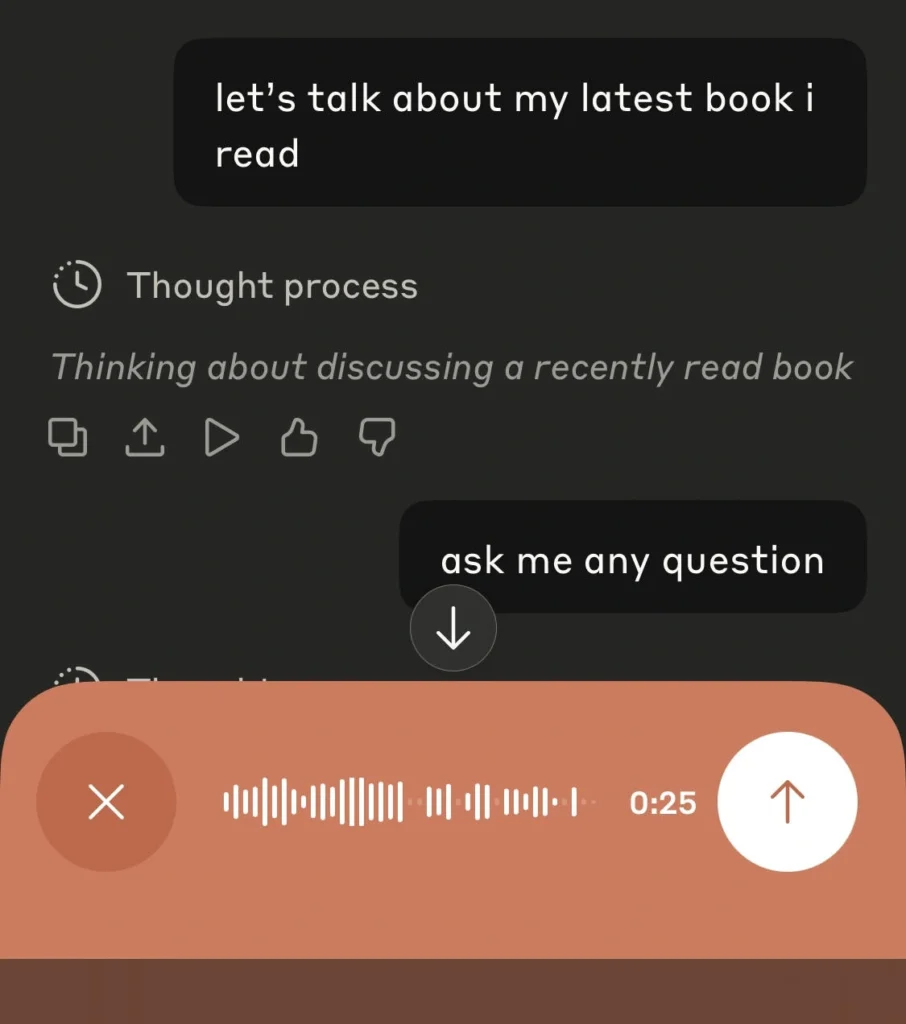
The easiest way to move from passive reading to active learning? Start talking. Voice AI conversations are the lowest-friction way to test your knowledge, practice complex ideas, and build confidence – all without judgment or pressure. Here’s why this approach works and how to get started.
Coming up: Conversational AI That Turns Learning From Books Into Play
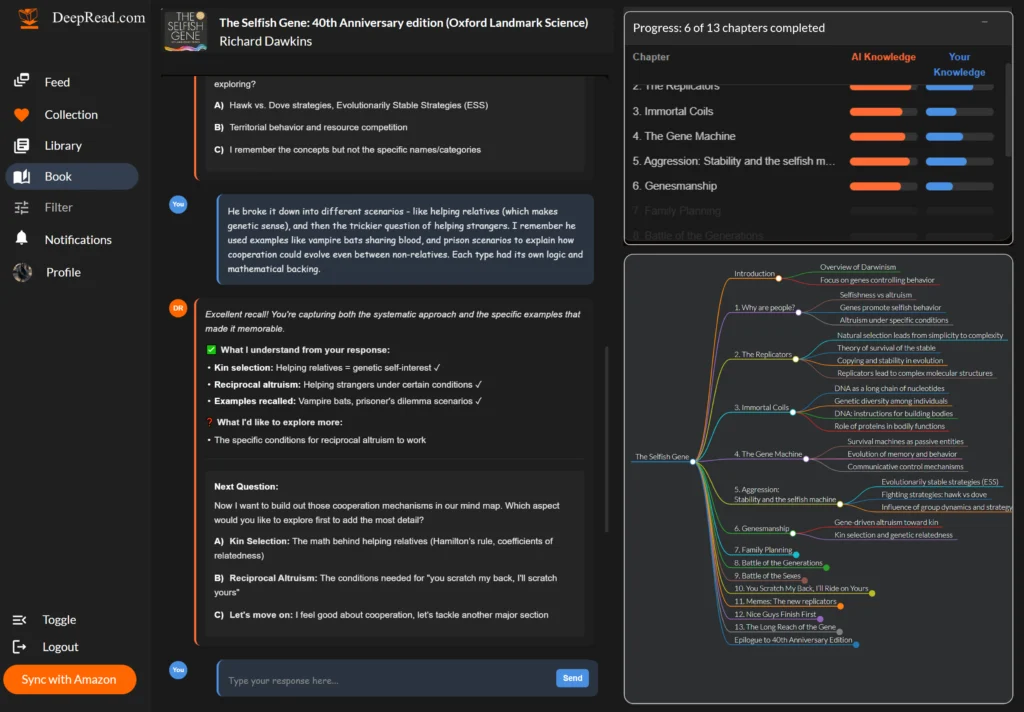
You’ve just finished a fascinating book, but within days those brilliant insights start slipping away—scattered, inaccessible, lost. You know you’re losing something valuable, but organizing it feels like too much work. What if securing those fleeting insights could actually be fun? What if a simple conversation could turn your scattered highlights into a structured mind map, sparking new connections and ideas you hadn’t even noticed? Our new conversational AI approach transforms the tedious work of knowledge management into an engaging dialogue that makes your insights stick. This feature is on our roadmap, and we’d love your feedback as we design it.
Audiobook with AI Co-Working: My New Learning Workflow

During my experiment to actively learn from audiobooks, I have started using AI to transform my pile of scribbled notes into a lasting knowledge graph. Now, I have discovered something counterintuitive: the best way to use AI for learning isn’t to let it summarize content for you, but to make it your co-worker in transforming your own imperfect recall into structured knowledge. Instead of asking AI to understand the book, I ask it to help me understand what I’ve understood—and the results are transforming my relationship with audio learning.
My Audiobook Workflow: How It Started vs. How It’s Going

A week ago, I started an experiment. Instead of falling into my usual pattern of buying both the audiobook and the ebook version of “Broken Money” by Lyn Alden, I decided to challenge myself: Could I extract maximum knowledge from just the audiobook? Could I build a comprehensive knowledge graph without ever opening the Kindle version?
The stakes feel higher than usual because this isn’t just about saving money or time. It’s about fundamentally changing how I approach learning from audiobooks. And honestly, I’m not sure it’s going to work.
Audiobooks: From Passive Consumption to Active Learning
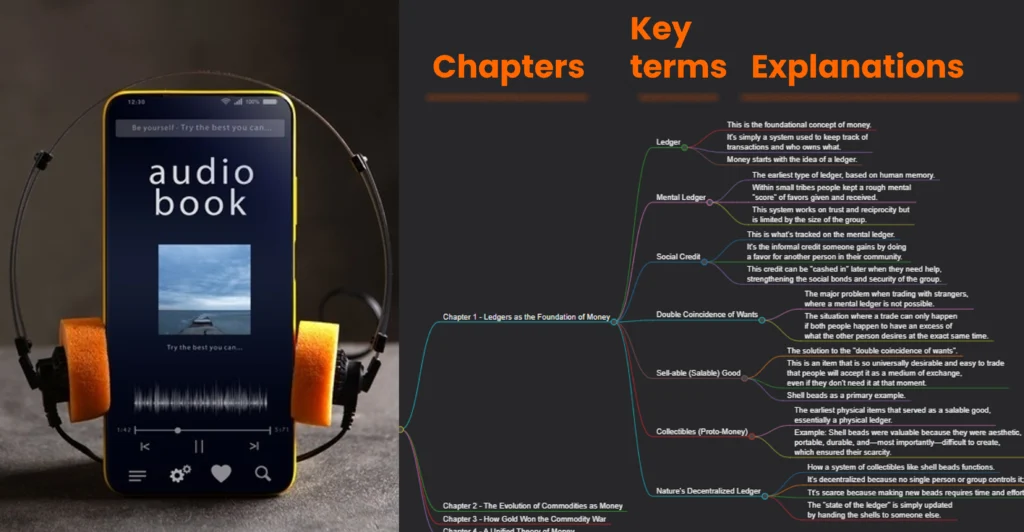
If you’re like most audiobook listeners, this scenario probably sounds familiar: You finish an excellent book, feeling inspired and full of new insights. A week later, someone asks you what the book was about, and you struggle to recall more than a few vague concepts. A month later, you can barely remember the main thesis.
Spaced Repetition Done Right: How to Remember Facts AND Structure with Anki
Flashcards combined with the Spaced Repetition System is a solid way to learn and remember the main ideas of what you read. With this approach you break down your book into small, digestible pieces of knowledge and create flashcards to trigger active recall. The Spaced Repetition Method makes sure that you test your memory at strategically timed intervals with shorter intervals for harder to remember content and longer intervals for easier content.
But there’s a challenge: when you break a book into individual pieces, you might lose sight of how everything connects. Depending on the type of book and your learning goals, you may need to preserve not just individual facts, but also the structure of arguments and how different concepts relate to each other. This can be achieved by adding cards that focus specifically on the book’s organization, or by including hints on regular cards that remind you where each piece of information fits in the author’s overall argument.
Nested Summarization: The Learning Technique So Basic It’s Genius
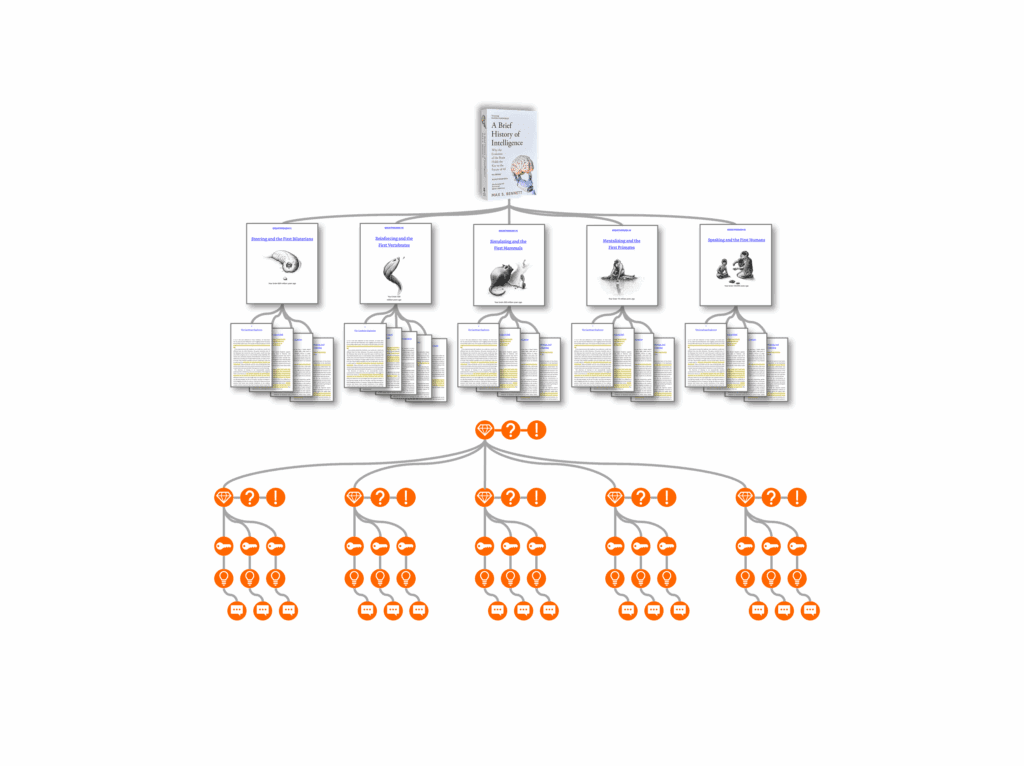
You’ve probably done it countless times without realizing it. When preparing for a crucial exam, you instinctively break down a textbook chapter by chapter, then section by section, distilling complex ideas into concise summaries that capture the essence of hundreds of pages in just a few key points. This natural learning pattern has a name: Nested Summarization.
This isn’t just another study hack—it’s the way our minds naturally organize and retain complex information. By working from the bottom up through a book’s hierarchical structure, you’re not just memorizing facts; you’re building a mental framework that transforms how you understand and remember knowledge.
Whether you’re a student cramming for finals, a professional mastering new skills, or a lifelong learner diving into complex subjects, Nested Summarization will change your approach to learning. It’s time to give this intuitive technique the recognition and systematic approach it deserves.
Bidirectional Links vs Hierarchical Note Taking: Which Method Actually Helps You Learn Better?
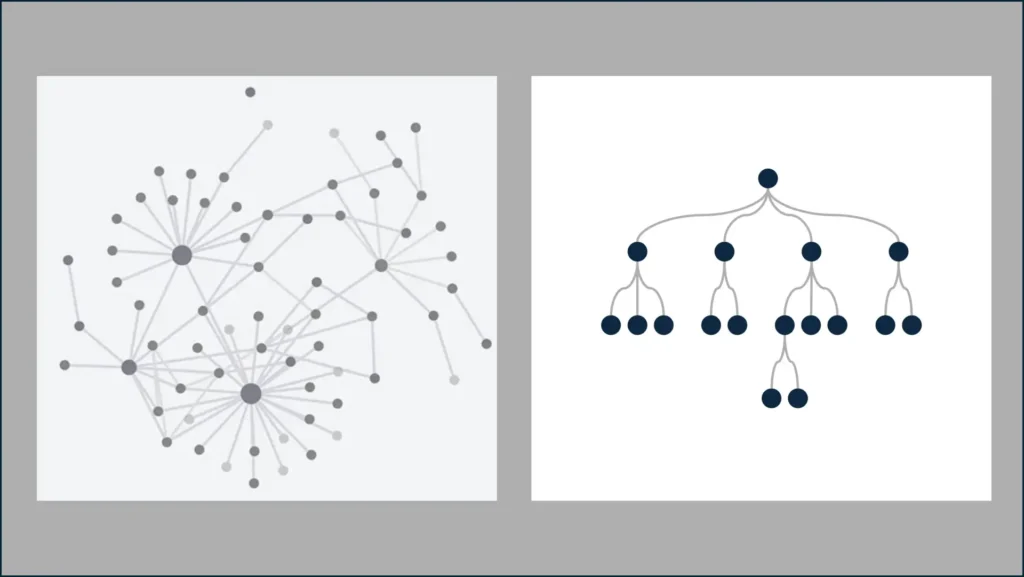
The world of knowledge management has been revolutionized by tools that promise to transform how we connect ideas. Apps like Obsidian, Roam Research, and Notion have introduced millions to the concept of bidirectional linking, creating beautiful knowledge graphs that look like neural networks of pure thought. But beneath the visual appeal lies a fundamental question: do these connected notes actually help us learn better, or are we being seduced by complexity that doesn’t serve our cognitive needs?
The Simple Zettelkasten: A Knowledge System That Actually Works (Without the Technical Headaches)
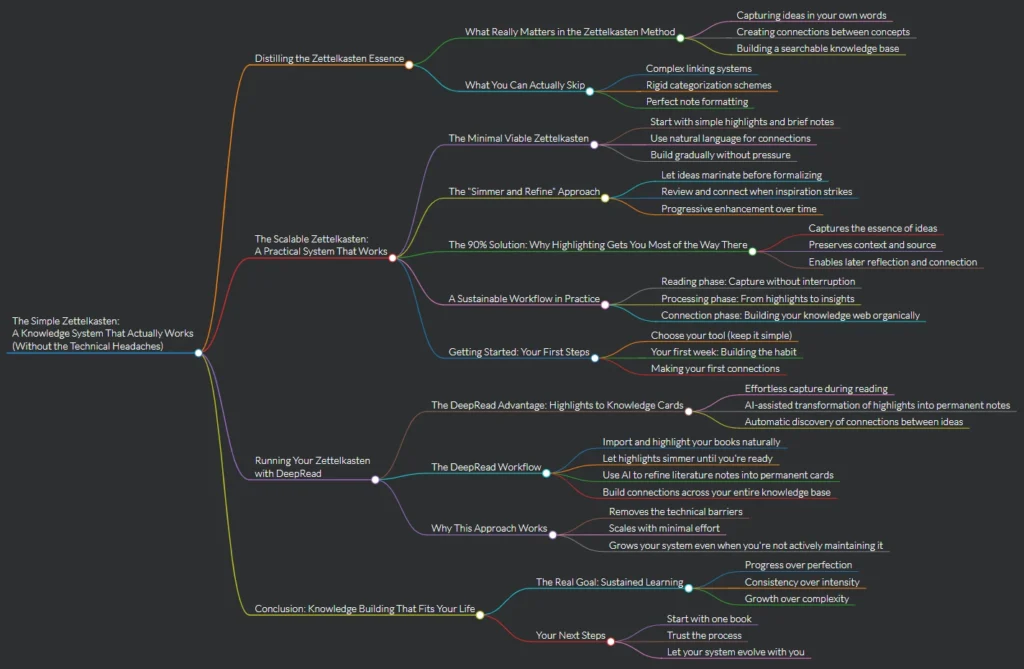
The Zettelkasten method promises to revolutionize how we think, learn, and connect ideas. Yet for every success story, there are countless abandoned note-taking systems gathering digital dust. The problem isn’t with the core concept—it’s with how we’ve made it unnecessarily complicated.