
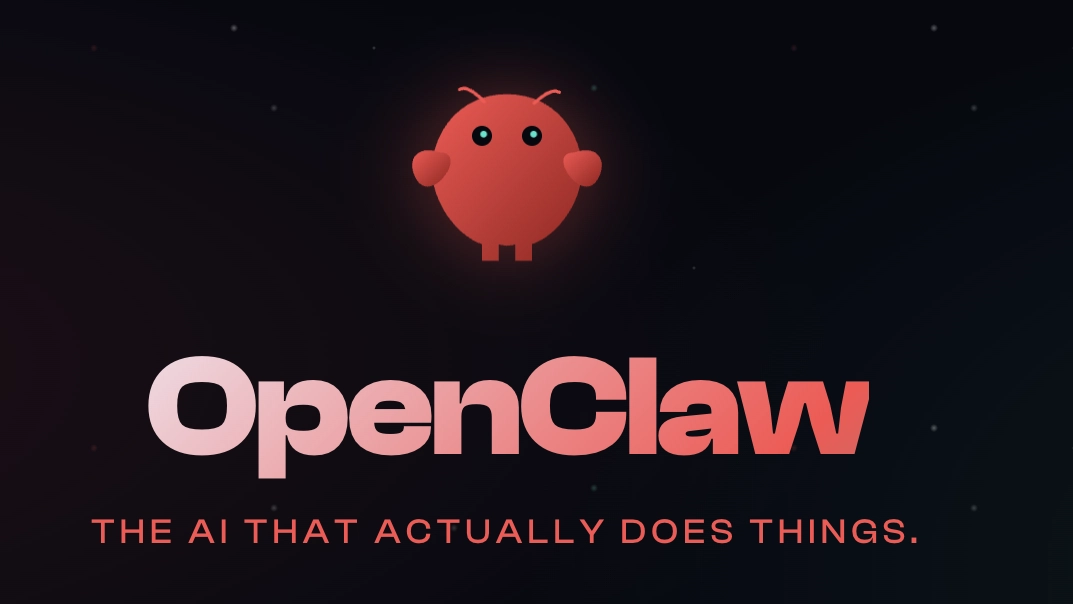
If you've been anywhere near tech Twitter this week, you've seen the lobster. OpenClaw - originally called Clawdbot, then briefly Moltbot after Anthropic requested a name change for trademark reasons - has become one of the fastest-growing open-source projects in GitHub history.
The story is almost absurd. Austrian developer Peter Steinberger built a personal AI assistant that runs on your own hardware and connects to messaging apps like WhatsApp, Telegram, and iMessage. Within days of going viral, Anthropic asked him to change the name (too similar to "Claude"). During the rename process, crypto scammers snatched both the old GitHub and Twitter handles in approximately ten seconds. The project has now settled on OpenClaw, with a lobster mascot that "molted into its final form."
But the chaos around the naming isn't the interesting part. What's interesting is what this tool represents: AI that doesn't just talk - it does.
Unlike ChatGPT or Claude in a browser window, OpenClaw runs continuously on your machine. It can execute shell commands, manage files, control your browser, send messages on your behalf, and remember everything across conversations. You text it like you'd text a colleague, and it actually completes tasks rather than just suggesting what you could do.
Here's the bold claim: OpenClaw and tools like it let you outsource nearly everything you have to do on a computer. Not just get advice about it - actually delegate it.
This matters because it forces a question most of us haven't seriously asked ourselves: What parts of your computer work do you actually enjoy? What sparks your creativity? Where does your unique human input add real value?
For most of us, the honest answer is uncomfortable. We spend hours on tasks that feel productive but are really just maintenance. Sorting emails. Scheduling. Researching things we'll forget. Managing files. The kind of work that fills a day but doesn't move anything meaningful forward.
What if you could hand all of that to an AI that runs in the background, and focus only on the parts where your creativity and judgment actually matter? The ideation. The first drafts. The decisions that require human intuition. The work that feels like play because you're genuinely good at it.
That's the shift OpenClaw represents. Not AI as another app demanding your attention, but AI as an employee handling the tedious work while you specialize in what only you can do.
The theory sounds nice. But what are people actually doing with this thing? Three patterns are emerging.
The simplest use case might be the most powerful. OpenClaw connects to messaging apps you already use - which means capturing a thought is as easy as texting yourself. But unlike a notes app where ideas go to die, OpenClaw can actually do something with them.
The system keeps daily journal notes of all your interactions in markdown files. Users are treating this as an automated second brain that's fully searchable and - crucially - actionable. Community-built skills like "second-brain," "morning-manifesto," and "Notebook" extend this further, syncing with tools like Obsidian and turning scattered thoughts into structured knowledge.
Jay Clouse from the Creator Science podcast dove deep into this use case:

The key insight: your ideas finally go somewhere productive instead of yet another note-taking graveyard.
The second pattern is speed. People are building things in minutes that would normally take hours - not because the AI writes perfect code, but because it handles all the setup, configuration, and tedious implementation while you focus on what you actually want to create.
The pattern here isn't that AI replaces your thinking. It's that AI handles the implementation so you can move quickly from idea to working prototype. You describe what you want, iterate on the result, and end up with something functional before you'd normally have finished setting up the project.
The third pattern is the most interesting to me: using AI to filter the noise so you don't have to.
Think about how you discovered social media. The excitement of endless content. The inspiration. Then slowly, the realization that you've lost hours to the algorithm. The value you get out stops matching the time and attention you put in. It becomes a distraction you have to actively fight.
OpenClaw offers the opposite trajectory. Instead of you going to the platforms, the bot goes for you. It reads through the posts, handles the distraction of videos and pictures and random political content the algorithm spices in, and brings back only what's actually valuable and actionable.
The bot does the attention-draining work. You get a short daily report with only what matters.
There's been a fear circulating about AI: that models trained on AI-generated content will enter a vicious cycle, becoming dumber as they feed on their own output instead of human creativity.
But tools like OpenClaw suggest a different possibility. What if AI handles what AI is good at - the tedious, repetitive, attention-consuming tasks - while humans specialize in what humans are good at?
Not a vicious cycle, but a virtuous one. A symbiotic relationship where AI amplifies human capability instead of replacing it. Where we can leverage our creativity even more because we're not exhausted by the drudgery around it.
The question shifts from "Will AI replace us?" to "What should we focus on now that we can outsource the tedious parts?"
That's a much more interesting question. And the answer is different for everyone - but it probably involves more creating and less consuming. More original ideas and less administrative overhead. More of the work that feels like play because you're genuinely engaged with it.
If you're curious about exploring this, my suggestion is to start with the simplest use case: idea capture.
OpenClaw's integration with Telegram or WhatsApp means you can jot down thoughts as easily as texting yourself. But unlike a notes app, those thoughts go into a system that can actually use them - search them, connect them, act on them.
It's easy to set up, and it offers an immediate mindset shift. Your ideas go somewhere productive. You can have the ease of mind to forget about an idea and think up new ones, knowing nothing is lost.
That's a big change from the usual cycle of capturing notes you'll never look at again, in yet another knowledge management system you'll eventually abandon.
I'm experimenting with OpenClaw myself, and I'll share what I learn as I go. This is a developing story - the technology is new, the community is building fast, and the possibilities are still being discovered.
But the core insight feels solid: AI that runs in the background handling drudgery might be more valuable than AI that demands your attention in another browser tab.
The lobster has molted. Let's see what it becomes.