
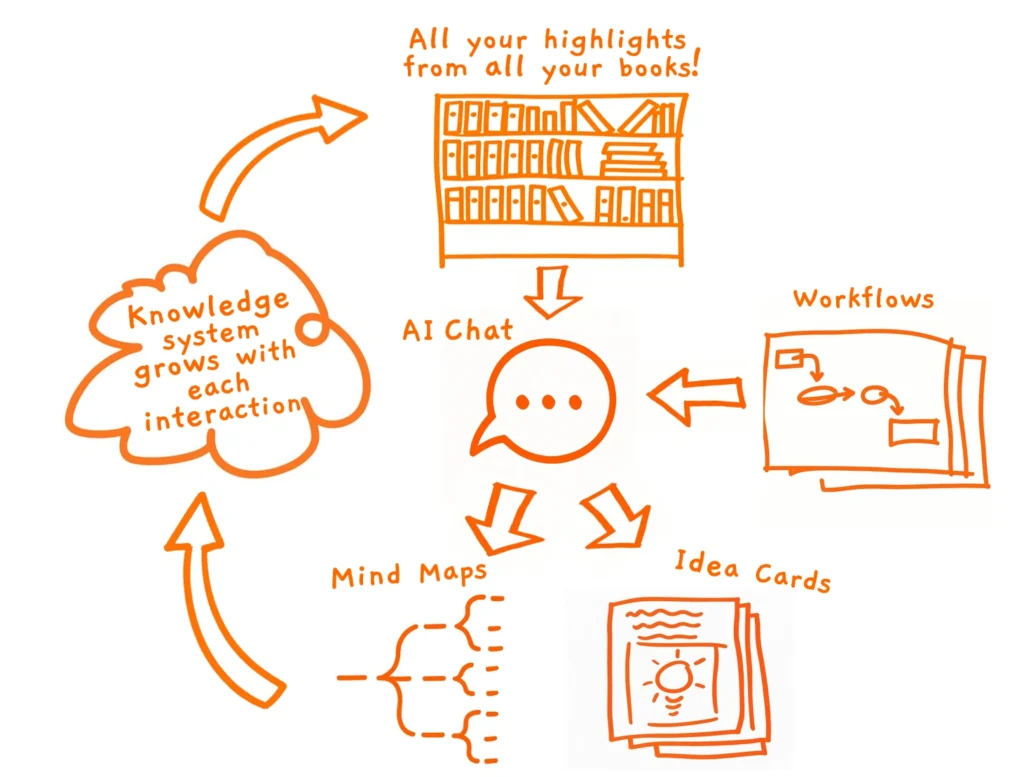
Imagine an AI with instant access to your entire reading library—every book, every highlight.
It navigates your knowledge, works with you through conversations, and creates tangible outputs: mind maps, idea cards, frameworks that reflect how you think.
Possible User Stories:
Ask questions across multiple books. Redirect as you think.
The AI searches entire books, chapters, and specific highlights—then synthesizes everything into a mind map.
What causes asset bubbles to burst? I've read different explanations.
Found 5 perspectives: Shiller (irrational exuberance), Kindleberger (credit cycles), Taleb (Black Swans), a chapter from your psychology book (herd behavior), plus a few highlights on tulip mania.
Skip Taleb. Check my monetary policy books instead.
Found it—Broken Money and Layered Money. Both describe structural mechanisms. Want me to contrast these with Shiller and Kindleberger?
Yes, show the mechanisms.
Not generic summaries—mind maps shaped by what you marked. Build through dialogue in minutes, not hours.
I just finished Thinking, Fast and Slow with tons of highlights. Help me build a mind map.
What drew you to it?
Decision-making at work. Focus on practical stuff—System 1 vs System 2, biases I can catch.
Building around: cognitive systems, workplace biases, applications. Anchoring under decision-making?
Perfect.
AI handles the complexity of scanning multiple books. You steer the direction. Difficult to build manually—effortless together.
Create a topic map on Stoic practices for modern life. I've read 6 books on this.
Found 4 core practices across your books: dichotomy of control, negative visualization, present-moment focus, virtue ethics.
Split 'dichotomy of control' into two themes—acceptance and action.
Done. Want to see how each author explains negative visualization differently?
Yes.
Don’t stare at a cursor trying to “write something smart.” Talk it through—AI articulates your thinking, formats it beautifully.
Help me create idea cards from Atomic Habits. I have 45 highlights.
I see patterns in what you marked. 6 concepts stand out as most actionable for you. Want to turn those into cards?
Yes, let's refine 3 together.
Here's the first—habit stacking. I've formatted it with your notes, added tags, and linked to your existing behavior change cards.
Perfect. Next one.
You see connections across books—AI helps you articulate them clearly. Your knowledge web grows with meaning, not just abstract links.
This error-correction concept in The Beginning of Infinity reminds me of feedback loops.
From your Thinking in Systems card? Want to explore that connection?
Yeah, both are self-correcting processes, but one's about knowledge and one's about systems.
So one is epistemological, one is systemic—but both show how iteration creates stability?
Exactly.
We’re recruiting a small group of dedicated readers to shape this Pro Setup with us from the start. Your needs and feedback will directly determine what we build.
Ready to shape the future of DeepRead? Join the co-development community.
What you get:
Your committment:
Check Noah Brier’s notetaking setup: The AI stores, reads, and writes to thousands of notes in his Obsidian vault.
For the technically curious:
Here’s how we’re approaching the architecture to make this possible.
Traditional AI chats load everything upfront and hit token limits fast. We’re using a filesystem-based approach where the AI dynamically searches and navigates your library—reading only what’s relevant for each query. This means no upload limits and true scalability across thousands of books.
We’re combining fuzzy text matching with semantic search to find what you’re looking for—whether you remember the exact phrase or just the general concept. The system can search across books, chapters, or individual highlights.
Each workflow (mind map, idea cards, etc.) is a structured guide that the AI follows—like a conversation script that adapts to your responses. New workflows can be added without changing the core system.
The AI maintains context across sessions—remembering your interests, projects, and how you think. It writes notes to itself about your library, so every conversation builds on the last.
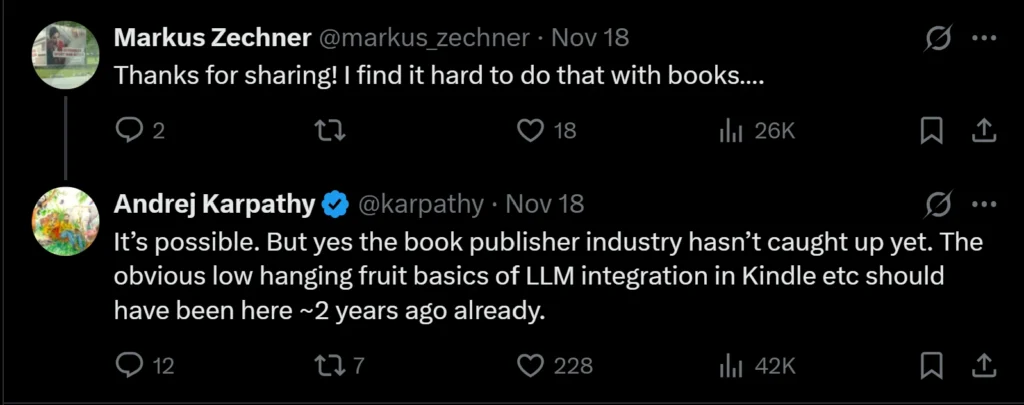
Thanks for sharing! I find it hard to do that with books….
— Markus Zechner (@markus_zechner) November 18, 2025